An elegant Byron fan site.
Some frequently reproduced portraits: moody, in Albanian garb, uncommonly handsome.
An animal emblem for Byron's verse style.
An non-academic (check the text before quoting, please!) but well-laid-out online edition of Don Juan, Canto I.
Tuesday, February 24, 2009


Friday, February 20, 2009
wordsworth and coleridge (2)
Wordsworth's two voices, and J. K. Stephen's 1891 parody.
One post-Wordsworthian sense of Nature. And another. And another.
Wordsworth and the Visible Man.
Once again, what Wordsworth would have seen "a few miles above Tintern Abbey," thanks to D. S. Miall: a modern-day view and the relevant plate from Samuel Ireland's Picturesque Views on the River Wye (1797), which describes Wordsworth's path. The Wye with sycamores (picture by Miall).
A very Wordsworthian picture (with two senses of "nature," if not many more).
Wordsworth's Immortality Ode.
Coleridge's "Dejection: An Ode."
The new moon with the old moon in her arms. John Constable's 1816 painting "Weymouth Bay."
A modern copy of a 17th-c. Aeolian harp. Another Aeolian harp, by the modern Canadian instrument maker David Johnson, but not far from early 19th-c designs. The "Aeolian lyre" in Thomas Gray.
One post-Wordsworthian sense of Nature. And another. And another.


Wordsworth and the Visible Man.


Once again, what Wordsworth would have seen "a few miles above Tintern Abbey," thanks to D. S. Miall: a modern-day view and the relevant plate from Samuel Ireland's Picturesque Views on the River Wye (1797), which describes Wordsworth's path. The Wye with sycamores (picture by Miall).
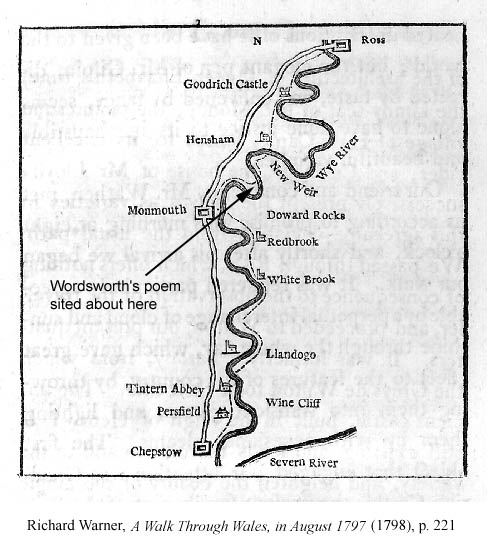


A very Wordsworthian picture (with two senses of "nature," if not many more).

Wordsworth's Immortality Ode.
Coleridge's "Dejection: An Ode."
The new moon with the old moon in her arms. John Constable's 1816 painting "Weymouth Bay."


A modern copy of a 17th-c. Aeolian harp. Another Aeolian harp, by the modern Canadian instrument maker David Johnson, but not far from early 19th-c designs. The "Aeolian lyre" in Thomas Gray.


Tuesday, February 17, 2009
wordsworth and coleridge (1)
The Wordsworth Centre.
A guide to the sprawling current standard academic edition of Wordsworth's poems, with brief descriptions of the major works.
The young Coleridge.
A first edition of the two-volume Lyrical Ballads.
One analogy, from another art form, for the effect of Lyrical Ballads.
Wordsworth as elderly sage, also as sage, and a pen-and-ink drawing of the poet young and worried.
Tintern Abbey, seen from across the Wye, 1794 (painting by Edward Dayes). Seen from across the River Wye right now. Seen, as Wordsworth might have seen it, from above and far away by a contemporary tourist (never mind the guy in the blue cap).
But the poem takes place, the title says, "a few miles above" (i.e. upstream from) Tintern Abbey-- probably about here, according to David S. Miall's arresting scholarly argument about what Wordsworth actually describes. A relevant plate from Samuel Ireland's Picturesque Views on the River Wye (1797), which describes Wordsworth's path. The Wye with sycamores (picture by Miall).
Some of Wordsworth's manuscripts in electronic facsimile (may require Explorer).
The Toronto online versions of some Wordsworth poems, including "Simon Lee" and the poem commonly known as "Tintern Abbey" and the Immortality Ode and the entirety of the first edition of Lyrical Ballads and the disturbing "Ode to Duty."
Dove Cottage and Rydal Mount. One tourist's view from Rydal Mount.
From UCSB, important events for the study of Romanticism, year by year.
From the University of Alberta, a set of resources for studying Coleridge's "Frost at MIdnight": multiple online texts, with an earlier version, biographical and critical background, and the makings of an essay about Coleridge, childhood grief, and attachment theory.
A guide to the sprawling current standard academic edition of Wordsworth's poems, with brief descriptions of the major works.
The young Coleridge.

A first edition of the two-volume Lyrical Ballads.

One analogy, from another art form, for the effect of Lyrical Ballads.
Wordsworth as elderly sage, also as sage, and a pen-and-ink drawing of the poet young and worried.


Tintern Abbey, seen from across the Wye, 1794 (painting by Edward Dayes). Seen from across the River Wye right now. Seen, as Wordsworth might have seen it, from above and far away by a contemporary tourist (never mind the guy in the blue cap).


But the poem takes place, the title says, "a few miles above" (i.e. upstream from) Tintern Abbey-- probably about here, according to David S. Miall's arresting scholarly argument about what Wordsworth actually describes. A relevant plate from Samuel Ireland's Picturesque Views on the River Wye (1797), which describes Wordsworth's path. The Wye with sycamores (picture by Miall).
Some of Wordsworth's manuscripts in electronic facsimile (may require Explorer).
The Toronto online versions of some Wordsworth poems, including "Simon Lee" and the poem commonly known as "Tintern Abbey" and the Immortality Ode and the entirety of the first edition of Lyrical Ballads and the disturbing "Ode to Duty."
Dove Cottage and Rydal Mount. One tourist's view from Rydal Mount.

From UCSB, important events for the study of Romanticism, year by year.
From the University of Alberta, a set of resources for studying Coleridge's "Frost at MIdnight": multiple online texts, with an earlier version, biographical and critical background, and the makings of an essay about Coleridge, childhood grief, and attachment theory.
Monday, February 9, 2009
johnson and blake
Samuel Johnson, looking authoritative.
Jack Lynch's guide to online resources for Johnson.
The Plan (i.e. proposal) for Johnson's Dictionary. The title page from the first edition.
Johnson's poem "On the Death of Dr. Robert Levet."
The Blake Archive at UVa.
The Blake Society.
From UVa, eleven different versions of Songs of Innocence and of Experience.
A title page for Innocence and Experience (copy L).
A title page for Songs of Innocence.
A title page from another copy of Songs of Innocence.
One version of "The Little Black Boy"; page two from the same copy; page two from another copy (note the boys' colors in each).
One version of "The Lamb"; another version.
One version of "The Tyger"; another version.
The UVa guide to electronic editions of "The Marriage of Heaven and Hell." One of many title pages.
The online Blake exhibit at Britain's Tate Gallery. The Tate's Web features (designed in part for secondary school students, I think) on Songs of Innocence and Experience.
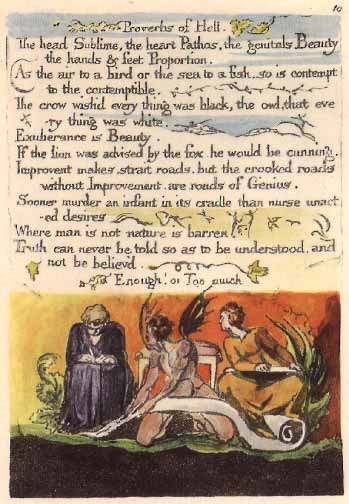
A beautiful (but amateur) online display of all the plates from one copy of The Marriage of Heaven and Hell. One plate from the Proverbs of Hell.

Jack Lynch's guide to online resources for Johnson.
The Plan (i.e. proposal) for Johnson's Dictionary. The title page from the first edition.

Johnson's poem "On the Death of Dr. Robert Levet."
The Blake Archive at UVa.
The Blake Society.
From UVa, eleven different versions of Songs of Innocence and of Experience.
A title page for Innocence and Experience (copy L).

A title page for Songs of Innocence.

A title page from another copy of Songs of Innocence.

One version of "The Little Black Boy"; page two from the same copy; page two from another copy (note the boys' colors in each).


One version of "The Lamb"; another version.


One version of "The Tyger"; another version.


The UVa guide to electronic editions of "The Marriage of Heaven and Hell." One of many title pages.

The online Blake exhibit at Britain's Tate Gallery. The Tate's Web features (designed in part for secondary school students, I think) on Songs of Innocence and Experience.
A beautiful (but amateur) online display of all the plates from one copy of The Marriage of Heaven and Hell. One plate from the Proverbs of Hell.
Sunday, February 8, 2009
"I have not made my opera throughout unnatural": The Beggar Skewers Italian Opera
*** for your listening pleasure ***
In the introduction to The Beggar's Opera, a beggar steps forward to say "he has not made my opera throughout unnatural like those in vogue; for I have no recitative." What does he mean by this?
He's poking fun at the Italian opera convention of recitative, a form of declamation which is halfway between speaking and singing and is characterized by bare-bones accompaniment. Italian opera composers would use recitative when they wanted to advance the plot, usually by setting dialogue. They would use arias (airs in English) to freeze the action and expand on what the actors were feeling (love, heartbreak, joy, anger), very often through the Petrarchan "similes" mentioned by the beggar: "the swallow, the moth, the bee, the ship, the flower, etc."
Below is an excerpt from one of the more extreme examples of accompanied recitative, which is half way between recitative and aria, and accompanied by orchestra. It's taken from Gay's earlier libretto for Handel, Acis and Galatea.
And here's a straighter example of recitative used to set dialogue between two characters, also taken from Acis and Galatea:
How does Handel convey each of the three verbs in the first example? What do you think English audiences might have found "unnatural" about recitative? Feel free to leave a comment.
In the introduction to The Beggar's Opera, a beggar steps forward to say "he has not made my opera throughout unnatural like those in vogue; for I have no recitative." What does he mean by this?
He's poking fun at the Italian opera convention of recitative, a form of declamation which is halfway between speaking and singing and is characterized by bare-bones accompaniment. Italian opera composers would use recitative when they wanted to advance the plot, usually by setting dialogue. They would use arias (airs in English) to freeze the action and expand on what the actors were feeling (love, heartbreak, joy, anger), very often through the Petrarchan "similes" mentioned by the beggar: "the swallow, the moth, the bee, the ship, the flower, etc."
Below is an excerpt from one of the more extreme examples of accompanied recitative, which is half way between recitative and aria, and accompanied by orchestra. It's taken from Gay's earlier libretto for Handel, Acis and Galatea.
Handel/Gay: "I rage—I melt—I burn!" (0:25)
And here's a straighter example of recitative used to set dialogue between two characters, also taken from Acis and Galatea:
Handel/Gay: "Whither fairest, art thou running" (0:20)
How does Handel convey each of the three verbs in the first example? What do you think English audiences might have found "unnatural" about recitative? Feel free to leave a comment.
Saturday, February 7, 2009
Music for Thieves
***for your listening pleasure***
What is the musical equivalent of thieving? Contrafactum, and John Gay's The Beggar's Opera is a good example of it. Contrafactum (cf. counterfeit) is just a fancy word for taking a preexisting song on the public radar and supplying it with new lyrics (Weird Al does it too). By taking highbrow songs (or religious ones) and giving them lowbrow lyrics (and vice versa), librettists like Gay could create ironic relationships between the original and its echo.
Below are some excerpts from The Beggar's Opera and the sources from which Gay and his arranger, Johann Christoph Pepusch, cribbed. What do you think people found so funny? Feel free to share your response in the comments below.
From Act I of the B.O.
Source: "What shall I do to show how much I love her?", from Purcell's opera, Dioclesian (0:30)
In fair Aurelia's arms leave me expiring,
To be embalm'd by the sweets of her breath;
To the last moment I'll still be desiring;
Never had hero so glorious a death.
B.O. (A1.S7, Air 6): "Virgins are like the fair flower in its luster" (0:30)
But, when once plucked, 'tis no longer alluring,
To Covent Garden, 'tis sent (as yet sweet),
There fades, and shrinks, and grows past all enduring,
Rots, stinks, and dies, and is trod under feet.
From Act 2 of the B.O.
Source: March from Handel's Rinaldo (0:10)
Christian crusaders march before the battle for Jerusalem.B.O. (A2.S2, Air 20): "Let us take the road" (0:22)
[The gang, ranged in the front of the stage, load their pistols, and stick them under their girdles; then go off singing the first part of the chorus.]Let us take the road.
Hark! I hear the sound of coaches!
The hour of attack approaches,
To your arms, brave boys, and load.
See the ball I hold!
Let the chemists toil like asses,
Our fire their fire surpasses,
And turns all our lead to gold.
the beggar's opera
Full text of the play (1728), and an articulate introduction, from the University of Oregon.
Still popular, in regional and local productions, attempts at authenticity with period instrumentation, the even more popular musical rewriting by Bertolt Brecht and Kurt Weill, another adaptation by former Czech president Vaclav Havel.
William Hogarth at the Tate Gallery; Hogarth's depiction of Beggar's Opera Act III, scene 11, as it may have looked in its first production on the London stage.
The title page from the first edition of the score for Handel's Rinaldo (1711).
Handel and Gay collaborate for Acis and Galatea (1719).
Prime Minister Robert Walpole.
The public hanging of Jack Sheppard.
Jonathan Wild, thief-taker, "great man," notorious criminal, on his way to the gallows.
A contemporary account of Jonathan Wild from The Complete Newgate Calendar (online at the Univ. of Texas).
"But gold from law can take out the sting..."
Still popular, in regional and local productions, attempts at authenticity with period instrumentation, the even more popular musical rewriting by Bertolt Brecht and Kurt Weill, another adaptation by former Czech president Vaclav Havel.


William Hogarth at the Tate Gallery; Hogarth's depiction of Beggar's Opera Act III, scene 11, as it may have looked in its first production on the London stage.

The title page from the first edition of the score for Handel's Rinaldo (1711).
Handel and Gay collaborate for Acis and Galatea (1719).

Prime Minister Robert Walpole.

The public hanging of Jack Sheppard.
Jonathan Wild, thief-taker, "great man," notorious criminal, on his way to the gallows.


A contemporary account of Jonathan Wild from The Complete Newgate Calendar (online at the Univ. of Texas).
"But gold from law can take out the sting..."


Tuesday, February 3, 2009
The Gulliver Suite (1728)
***for your listening pleasure***
Two years after Gulliver's Travels was published, it was set to music in Germany. Georg Philipp Telemann's Gulliver Suite is one of twenty five "lessons" serialized in The Steadfast Music Teacher for the enjoyment of music makers at home. The suite, written for two violins, became an instant sensation. After all, who wouldn't want to follow Gulliver on his exciting journey?
Like Swift, Telemann was interested in the body human, and in particular, the body in movement. Swift's satire gave Telemann the idea for a programmatic dance suite, each of whose movements imagines Swift's characters in terms of musical gestures. Some short excerpts follow.
Lastly, here is what score for the Lilliput Chaconne and Brobdingnag Gigue looks like. You don't need to know how to read music to understand the visual joke being played here.

Two years after Gulliver's Travels was published, it was set to music in Germany. Georg Philipp Telemann's Gulliver Suite is one of twenty five "lessons" serialized in The Steadfast Music Teacher for the enjoyment of music makers at home. The suite, written for two violins, became an instant sensation. After all, who wouldn't want to follow Gulliver on his exciting journey?
Like Swift, Telemann was interested in the body human, and in particular, the body in movement. Swift's satire gave Telemann the idea for a programmatic dance suite, each of whose movements imagines Swift's characters in terms of musical gestures. Some short excerpts follow.
Intrada (0:10)
More bold than stately, the opening procession sees Gulliver off on his voyage.Lilliputian Chaconne (0:17)
The chaconne has music as sprightly as the little people it depicts.Brobdingnagian Gigue (0:20)
By contrast, the gigue imitates the clumsy steps of giants. Gigues are typically fast-moving dances. This one, not so much.Reverie of the Laputans and their attendant flappers (0:10)
The music of the Laputans is precious to the point of sleep-inducing, hence the title, reverie.Loure of the Well-Mannered Houyhnhnms and Wild Dance of the Untamed Yahoo (0:25)
The fifth and final dance, a loure, sets the civilized against the barbaric." Can you guess which violin is which?Lastly, here is what score for the Lilliput Chaconne and Brobdingnag Gigue looks like. You don't need to know how to read music to understand the visual joke being played here.

swift and pope
Title page from the first edition of Gulliver's Travels.
Verses on the Death of Dr. Swift (Toronto RPO edition).
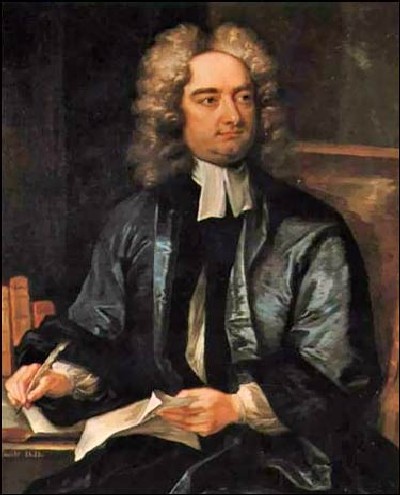
Swift's portrait, painted 1718.
Tory writers liked and remembered Queen Anne.
A less attractive Hanoverian monarch.
Eighteenth-century Ireland, in the abstract.
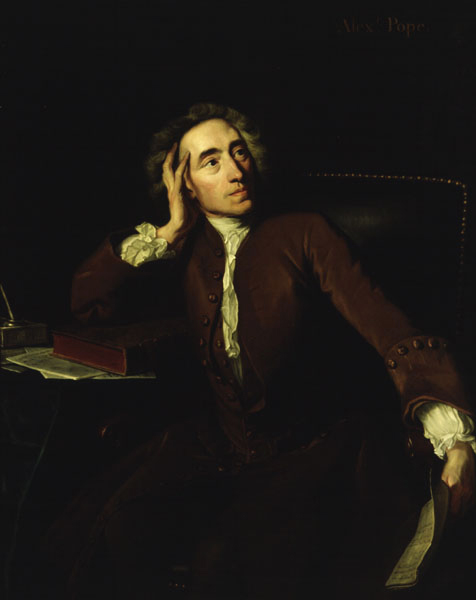
Alexander Pope, in an engraving (date unavailable) and in a portrait painted 1742.
Some of Pope's poems (RPO).
An especially "Augustan" title page (to a 1714 collection of poems, many by Pope).
A page from an early edition of The Dunciad.
Arabella Fermor, in an engraving (small image).
A contemporary mock epic.
Swift's "Advice to the Grub-Street Verse Writers," with a nod to Pope.
Being famous.
What contemporary popular genre most resembles Pope's self-presentations?

Verses on the Death of Dr. Swift (Toronto RPO edition).
Swift's portrait, painted 1718.
Tory writers liked and remembered Queen Anne.

A less attractive Hanoverian monarch.

Eighteenth-century Ireland, in the abstract.

Alexander Pope, in an engraving (date unavailable) and in a portrait painted 1742.

Some of Pope's poems (RPO).
An especially "Augustan" title page (to a 1714 collection of poems, many by Pope).

A page from an early edition of The Dunciad.

Arabella Fermor, in an engraving (small image).

A contemporary mock epic.
Swift's "Advice to the Grub-Street Verse Writers," with a nod to Pope.
Being famous.

What contemporary popular genre most resembles Pope's self-presentations?


Sunday, February 1, 2009
rochester, dryden and swift
A symbol for much Restoration and Augustan literature generally.
The BBC's British history timeline, from the Neolithic to last week, and the segment that includes the Restoration (when Rochester wrote).
A stereotype, with some truth in it, about King Charles II.
A famous portrait of Lord Rochester.
Rochester's verse satire against King Charles II.
Rochester's poem "The Disabled Debauchee."
Rochester's poem in tercets "Upon Nothing."
St Patrick's Cathedral, in Dublin.
An adult Houyhnhnm.
John Dryden's selected works from the University of Toronto site; Dryden's elegy to John Oldham.
Dryden's monument in Westminster Abbey.

The BBC's British history timeline, from the Neolithic to last week, and the segment that includes the Restoration (when Rochester wrote).
A stereotype, with some truth in it, about King Charles II.

A famous portrait of Lord Rochester.
Rochester's verse satire against King Charles II.
Rochester's poem "The Disabled Debauchee."
Rochester's poem in tercets "Upon Nothing."
St Patrick's Cathedral, in Dublin.

An adult Houyhnhnm.

John Dryden's selected works from the University of Toronto site; Dryden's elegy to John Oldham.
Dryden's monument in Westminster Abbey.


Subscribe to:
Posts (Atom)