The Poetry@Harvard site, now live.
Horace, Odes I:34 (the basis for Heaney's "Anything Can Happen") in Latin and in an 1882 English translation.
A map of Northern Ireland.
Heaney's 1995 Nobel Lecture.
Heaney at the London-based Poetry Archive, with audio.
Heaney reading "The Tollund Man," with audio and an image, from PBS.
From the Lannan Foundation, a long interview between Heaney and Dennis O'Driscoll, with Heaney reading his own work.
Photographs of the bog corpses described in P. V. Glob's book.
A mural in Derry remembering Bloody Sunday.
Muldoon's 1980 poem "Cuba."
Muldoon's own site. Muldoon's rock band, Wayside Shrines.
Audio that works: Muldoon reads his own poems. Muldoon reads "Meeting the British."
Muldoon at the Poetry Foundation, with a couple of poems.
All the books by Paul Muldoon (with photo).
A few of Heaney's poems at the Poetry Foundation, including the whole sequence "Glanmore Sonnets."
All the books by Heaney, with recent photo.
Helen Vendler's eulogy for Heaney.
Tuesday, April 28, 2009


Sunday, April 26, 2009
Caryl Churchill
Churchill's new and controversial short play Seven Jewish Children: the full text. The controversy, and an online video of a reading.
Reviews for Far Away from the Guardian, from the Village Voice, and the New York Times. Program notes from the Royal Court Theatre in London.
Also from the Guardian, a photo essay celebrating Churchill's 70th birthday in 2008.
Stills from productions: at Austin Community College (act II); at Philadelphia's Flashpoint Theatre; at Dartmouth College (act I); in Australia, from the Black Swan Theatre Company in Perth (follow internal link for a slideshow).
A series of stills from the production at the Univ. of Iowa. Hat specialists work on a production in Seattle.
Atul Gawande in the New Yorker on solitary confinement and torture.
Act III: the eye of an enemy. An enemy. Another enemy. A very dangerous enemy.
Reviews for Far Away from the Guardian, from the Village Voice, and the New York Times. Program notes from the Royal Court Theatre in London.
Also from the Guardian, a photo essay celebrating Churchill's 70th birthday in 2008.
Stills from productions: at Austin Community College (act II); at Philadelphia's Flashpoint Theatre; at Dartmouth College (act I); in Australia, from the Black Swan Theatre Company in Perth (follow internal link for a slideshow).

A series of stills from the production at the Univ. of Iowa. Hat specialists work on a production in Seattle.
Atul Gawande in the New Yorker on solitary confinement and torture.
Act III: the eye of an enemy. An enemy. Another enemy. A very dangerous enemy.


Wednesday, April 22, 2009
A few poets: Auden and afterwards
Visual early Auden: a Pennine valley, and a worked-out mine.
Pieter Brueghel the Elder, Landscape with the Fall of Icarus (1558?).
Auden's "Lullaby" (from the Academy of American Poets).
More of Auden's poems (from the Academy, with some audio). Auden reading his poems in New York City in 1972, from the New York Times. The Auden society.
The Philip Larkin society (weird-looking site design alludes to Larkin's poem "Toads"; some links don't work). Unglamorous Hull city centre, today; a road by Pearson Park, where Larkin lived, and a tiny image of Larkin's own flat. And Byrnmor Jones Library, Univ. of Hull.
Larkin's "High Windows. More Larkin poems in reliable versions online, from the Poetry Foundation.
Also from the Foundation, Geoffrey Hill; some segments from Mercian Hymns.
The Kings of Mercia.


Pieter Brueghel the Elder, Landscape with the Fall of Icarus (1558?).
Auden's "Lullaby" (from the Academy of American Poets).
More of Auden's poems (from the Academy, with some audio). Auden reading his poems in New York City in 1972, from the New York Times. The Auden society.
The Philip Larkin society (weird-looking site design alludes to Larkin's poem "Toads"; some links don't work). Unglamorous Hull city centre, today; a road by Pearson Park, where Larkin lived, and a tiny image of Larkin's own flat. And Byrnmor Jones Library, Univ. of Hull.


Larkin's "High Windows. More Larkin poems in reliable versions online, from the Poetry Foundation.
Also from the Foundation, Geoffrey Hill; some segments from Mercian Hymns.
The Kings of Mercia.
Wednesday, April 15, 2009
Yeats and Woolf
From the Academy of American Poets, a reliable text for Sailing to Byzantium."
From the Academy, "A Prayer for My Daughter."
Byzantine art in Ravenna: mosaic of Justinian; a detail with a head; a Byzantine church interior from Ravenna.
The Stone Cottage where Yeats lived with Pound as his assistant for parts of 1913-16.
Art in Bloomsbury: Vanessa Bell by Duncan Grant (1915). Virginia Woolf by Vanessa Bell (1912).
From the Academy, "A Prayer for My Daughter."
Byzantine art in Ravenna: mosaic of Justinian; a detail with a head; a Byzantine church interior from Ravenna.


The Stone Cottage where Yeats lived with Pound as his assistant for parts of 1913-16.

Art in Bloomsbury: Vanessa Bell by Duncan Grant (1915). Virginia Woolf by Vanessa Bell (1912).

Monday, April 13, 2009
Yeats: some drafts
Click this link, then scroll down and click again, to enlarge a manuscript page from the drafts of "Sailing to Byzantium."
Some drafts for stanza 2 (with hints that ended up elsewhere in the poem, esp. stanza 8) of "A Prayer for My Daughter" (1919), starting with the earliest surviving fragment of the poem:
God grant my prayer
Nor am I the first father that has stood
here
And judgedthe here beside this cradle hood
seeing thinking that
And seeing that a popular tempest blew
all
As though to make things aknew new
According to opinion driven men wild
Decides that some ( )
As this opinion wound, had driven men wild
And filled their hearts with bitterness
Feared for this child unless
For Had fear
Had dread for this child's peace unless
Heaven pour abounding sweetness on the child
******
And it may [be] another father stood
And gazed upon a head belowthis that hood
And thinking what a popular tempest blew
That all things
And thinks if all men's minds anew
And That all must be with opinion driven wild
And full of dusty bitterness
Shudder for that child's peace unless
****
It may be that soon
Considering that this cradle old may be
Some other father hashad like had like reverie
When the wind rose, I thought ( ) bless
Until all things were made anew
All must be with opinion driven wild
Andchoked with full of dusty bitterness
Trembling |And shuddered for his child's play peace unless
Heaven pour abounding sweetness on his child.
***
Nor am I |I am not the first father that has
Many another father may have stood
Where And weighed ( )
As I stand now beside this cradle-hood
Time | And judged by theblast beside
And as all times have trouble, this own
Thought thestorm beaten the world fell stone upon stone
and that the masters of the world ran
The world fell while its masters had gone wild
And racked his brain to think of all
That might that sleeping child befall
And what were the best prayer to pray for the
And prayed as I some charmed gift for his child
And what to ask of heaven for the child
And what prayer might be best
(Quoted in Jon Stallworthy, Between the Lines: Yeats' Poetry in the Making, Oxford: Clarendon, 1963, pp29-33)
Some drafts for stanza 2 (with hints that ended up elsewhere in the poem, esp. stanza 8) of "A Prayer for My Daughter" (1919), starting with the earliest surviving fragment of the poem:
God grant my prayer
Nor am I the first father that has stood
here
And judged
And
all
As though to make things a
As this opinion wound, had driven men wild
And filled their hearts with bitterness
For Had fear
Had dread for this child's peace unless
Heaven pour abounding sweetness on the child
******
And it may [be] another father stood
And gazed upon a head below
And thinking what a popular tempest blew
And thinks if all men's minds anew
And full of dusty bitterness
Shudder for that child's peace unless
****
Considering that this cradle old may be
Some other father has
When the wind rose, I thought ( ) bless
Until all things were made anew
All must be with opinion driven wild
And
Trembling |
Heaven pour abounding sweetness on his child.
***
Nor am I |
Time | And judged by the
And as all times have trouble, this own
Thought the
and that the masters of the world ran
And racked his brain to think of all
That might that sleeping child befall
And what to ask of heaven for the child
(Quoted in Jon Stallworthy, Between the Lines: Yeats' Poetry in the Making, Oxford: Clarendon, 1963, pp29-33)
Yeats: a letter about Easter 1916
Yeats to Lady Gregory, May 11, 1916: "The Dublin tragedy has been a great sorrow and anxiety... I see that an old friend-- unless there are two of the name-- who began with me the whole work of the literary movement has been shot in a barrack yard without trial of any kind....
"I am trying to write a poem on the men executed-- 'terrible beauty has been born again.' If the English Conservative party had made a declaration that they did not intend to rescind the Irish Home Rule bill there would have been no Rebellion. I had no idea that any public event could so deeply move me-- and I am very despondent about the future. At the moment I feel that all the work of years has been overturned, all the bringing together of classes, all the freeing of Irish literature and criticism from politics.
"Maud Gonne reminds me that she saw the ruined houses about O'Connell Street and the wounded and dying lying about in the streets, in the first few days of the war. I perfectly remember the vision and my making light of it and saying that if a true vision at all it could only have a symbolised meaning.
"This is the only letter I have had from her since she knew of the Rebellion. I have sent her the papers every day. I do not yet know what she feels about her husband's death. Her letter was written before she heard of it. Her main thought seems to be' tragic dignity has returned to Ireland.'" (Quoted in A. N. Jeffares, A Commentary on the Collected Poems of W. B. Yeats, London: Macmillan, 1968, pp225-26)
Tuesday, April 7, 2009
Yeats
Under Ben Bulben in present-day Sligo. The same scene, seen from the sea.
"The Lake Isle of Innisfree," an early "hit."
An accurate (but ugly) text for "Who Goes with Fergus?"
The final (1925) version of "The Sorrow of Love."
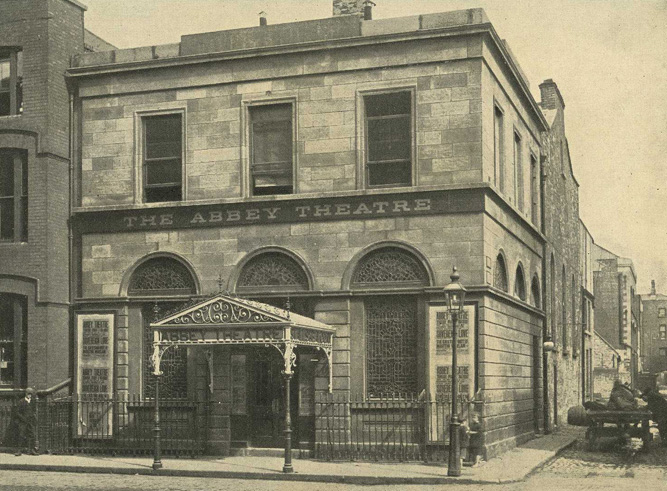
The original Abbey Theatre in Dublin.
"The Fascination of What's Difficult."
18th-century Dublin houses. The Easter Rising proclamation; an Irish memorial to the dead of the Easter Rising, with Yeats' lines from "Easter 1916" inscribed. The Dublin General Post Office after the Easter Rising.
"Easter 1916."
Another reliable text for "Easter 1916," with links to contemporary American poets reading parts of that poem.
Yeats's Tower. Another view. John Rickard's photographs of Coole Park and Thoor Ballylee, where Yeats spent part of each year from 1918 to the late 1920s. The restored Coole Park, with deer, in a recent photograph.
A map of troop deployments from the Irish Civil War.
Most links to poems here come from the Yeats page at the Poetry Foundation, likely the only online source for reliable texts to many of these poems; Yeats' later poems are still under copyright, though these are in the public domain in the United States.
Ezra Pound's review of Yeats's Responsibilities (1914).
Some audio files: "It gave me a devil of a lot of trouble to get them into verse"; the Lake Isle. (More audio files on Monday from CD.)
On the first appearance of "Who Goes with Fergus?" (as quoted by M. L. Rosenthal).
Some diagrams and excerpts from Yeats' A Vision. Neil Mann's elaborate explication of A Vision, with more diagrams.


"The Lake Isle of Innisfree," an early "hit."
An accurate (but ugly) text for "Who Goes with Fergus?"
The final (1925) version of "The Sorrow of Love."
The original Abbey Theatre in Dublin.
"The Fascination of What's Difficult."
18th-century Dublin houses. The Easter Rising proclamation; an Irish memorial to the dead of the Easter Rising, with Yeats' lines from "Easter 1916" inscribed. The Dublin General Post Office after the Easter Rising.


"Easter 1916."
Another reliable text for "Easter 1916," with links to contemporary American poets reading parts of that poem.
Yeats's Tower. Another view. John Rickard's photographs of Coole Park and Thoor Ballylee, where Yeats spent part of each year from 1918 to the late 1920s. The restored Coole Park, with deer, in a recent photograph.


A map of troop deployments from the Irish Civil War.

Most links to poems here come from the Yeats page at the Poetry Foundation, likely the only online source for reliable texts to many of these poems; Yeats' later poems are still under copyright, though these are in the public domain in the United States.
Ezra Pound's review of Yeats's Responsibilities (1914).
Some audio files: "It gave me a devil of a lot of trouble to get them into verse"; the Lake Isle. (More audio files on Monday from CD.)
On the first appearance of "Who Goes with Fergus?" (as quoted by M. L. Rosenthal).
Some diagrams and excerpts from Yeats' A Vision. Neil Mann's elaborate explication of A Vision, with more diagrams.
Subscribe to:
Posts (Atom)